Is NCSA Worth it?
Is NCSA Worth the Money for College Athletes? A Recruiting Parent’s Perspective
By Joelle Merschman, Founder of Athletes Edge Recruiting
Is NCSA worth the money? For some families, it can be. Our family purchased a membership for our daughter because we wanted guidance, answers, and reassurance that we were taking the right steps.
We spent over $5,000. That was a significant investment—but hey, that’s what we do to support our kids as they chase their dreams. We believed in her goals and wanted to help her pursue them.
NCSA had good information. For our family, the challenge was finding time to use the support alongside everything else our daughter already had on her schedule.
That experience helped shape how we serve families at Athletes Edge Recruiting: personal guidance, accessible education, and professional digital profiles that help athletes take ownership of their recruiting journey.
Why Our Family Purchased NCSA
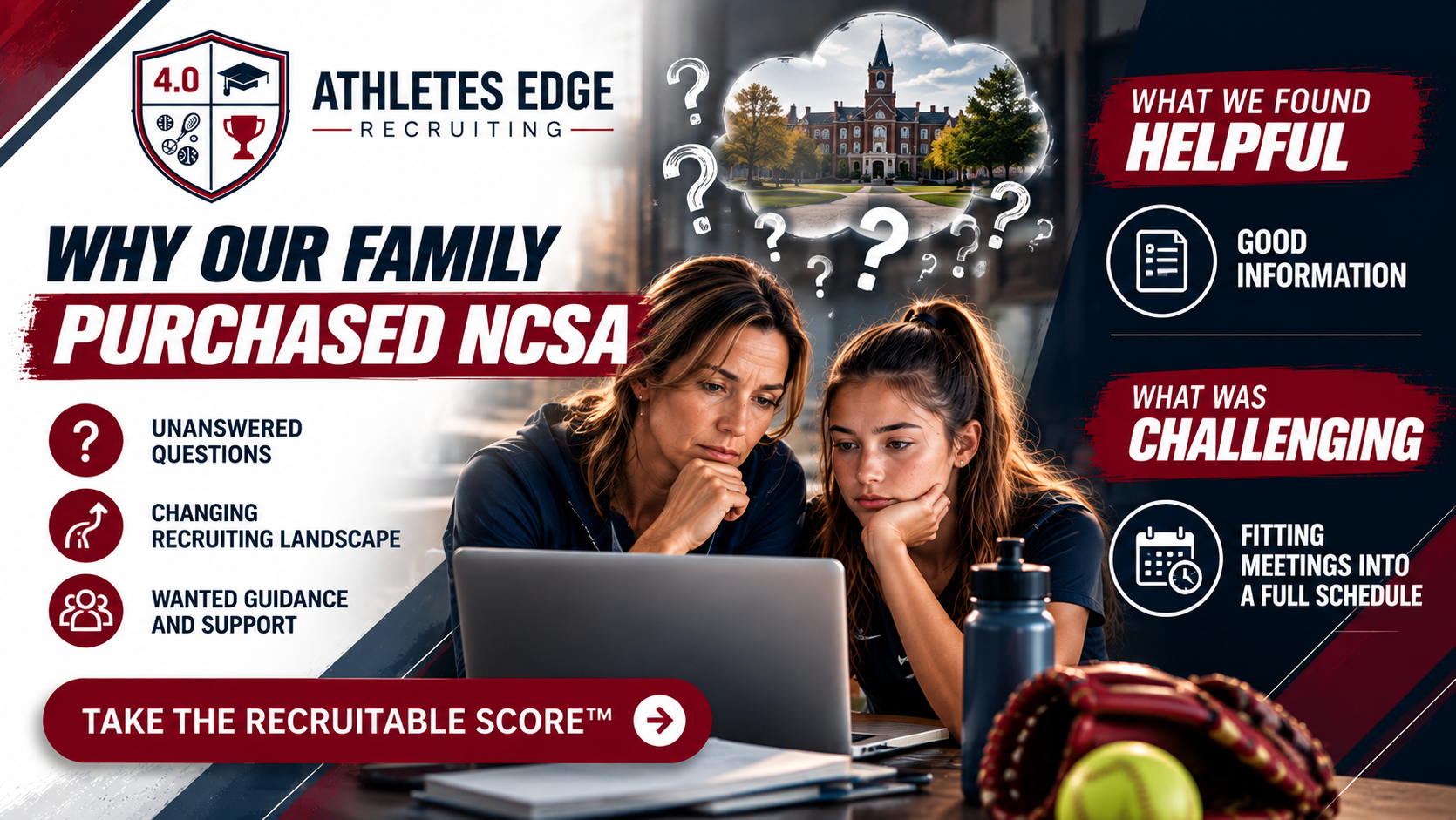
We had unanswered questions.
Were we doing this correctly? Were we missing something? What should our daughter be doing next?
The recruiting landscape had changed considerably since my husband and I attended college—and even since our son went to college about 10 years earlier. Being parents who had already sent one child to college didn’t mean we automatically understood the process for our daughter.
We wanted someone to help us make sense of it. I understand why families seek recruiting support, because we were that family.
What We Found Helpful—and Challenging
NCSA provided good information. Having access to recruiting guidance was valuable when we were trying to understand an unfamiliar process.
The difficult part was fitting scheduled meetings into an already full week.
Our daughter had pitching lessons, hitting lessons, training, school, and homework. We also needed time together as a family. Meeting with her NCSA coach meant finding another opening in that schedule.
Some evenings she had extra homework. Other evenings were more flexible, but they didn’t necessarily line up with a scheduled meeting. At times, participating felt like another commitment we had to manage.
That was our experience with the membership we purchased. Other families may appreciate scheduled meetings and find that structure helpful.
My advice is to consider both the information a service provides and how your family will realistically access and use it.
What Makes Athletes Edge Recruiting Different?
Our experience as recruiting parents influences the way we work with athletes and families. We emphasize flexibility, education, organized information, and athlete responsibility.
At Athletes Edge Recruiting, we help athletes organize their information and build the confidence to lead their recruiting journey.
Questions Can Be Asked on Your Family’s Schedule
Questions rarely arrive at a convenient appointment time.
They come up after a tournament, while registering for a camp, or when an athlete is getting ready to email a coach.
At AER, families can submit questions when they arise. They don’t need to save them for a preset appointment or attend a scheduled video session to access our guidance. Being able to ask anytime gives families flexibility; it doesn’t mean every question receives an immediate response.
We want recruiting education to fit into an athlete’s life and help them move forward.
We Build a Custom Digital Profile
Recruiting information can quickly become scattered.
An athlete’s video might be in one email, a transcript in another, and statistics somewhere else. That makes it harder to present a clear, complete picture.
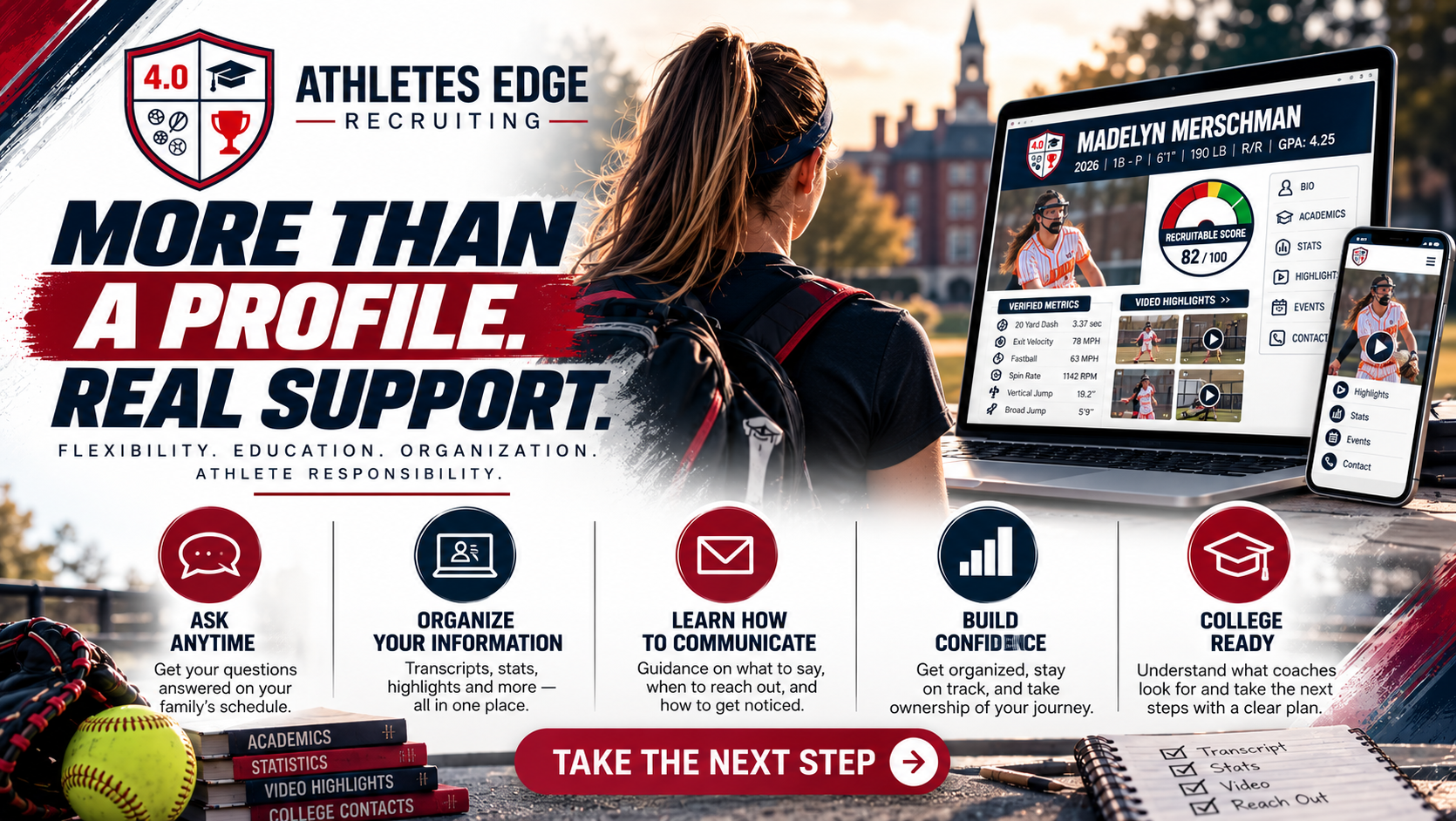
An athlete's digital profile brings your transcripts, statistics, highlights, and contact information together in one place.
We use online forms to collect information and build a custom digital profile that brings the athlete’s materials together.
An organized recruiting profile helps college coaches find the information they need to evaluate your athlete.
The goal is a professional presentation that makes relevant information easier to find and share. Athletes still need accurate information and current footage, but they have an organized foundation for communicating with coaches.
We Teach Athletes How to Communicate
A profile is useful when an athlete knows how to introduce themselves and share it.
We help athletes find publicly available coach email addresses and guide them on communicating before and after camps: what to send, when to send it, and how to make their introduction relevant.
For example, a pitcher’s introduction could include their graduation year, height, throwing hand, GPA, and a clear link to their profile. Before a camp, they can explain that they’ll be attending and why they’re interested in the program. Afterward, they can send a thoughtful follow-up.
Those steps help athletes practice taking initiative and communicating professionally.
What Conversations at a Recent Camp Taught Me
At a camp this past weekend, I spoke with girls who weren’t sure what an academic transcript was or whether their statistics were verifiable.
Some were juniors and seniors who already felt behind.
Those conversations reinforced how much basic recruiting education matters. Before families can decide which tools to purchase, athletes need to understand what information they should gather and how to use it.
Strong college recruiting preparation starts with understanding what coaches need before you begin reaching out.
We encouraged them to begin with manageable steps:
Obtain their current academic transcript.
Gather accurate statistics and identify their sources.
Organize relevant video and athletic information.
Present those materials in a professional digital profile.
Begin learning how to communicate with programs that interest them.
Attending an exposure event gives coaches an opportunity to evaluate an athlete. The athlete’s preparation, communication, academics, and presentation help provide additional context.
For a worried parent, having a clear next step can ease some of the uncertainty behind those late-night questions: Are we doing enough? Are we focusing on the right things?
Guidance From People Who Have Traveled This Path
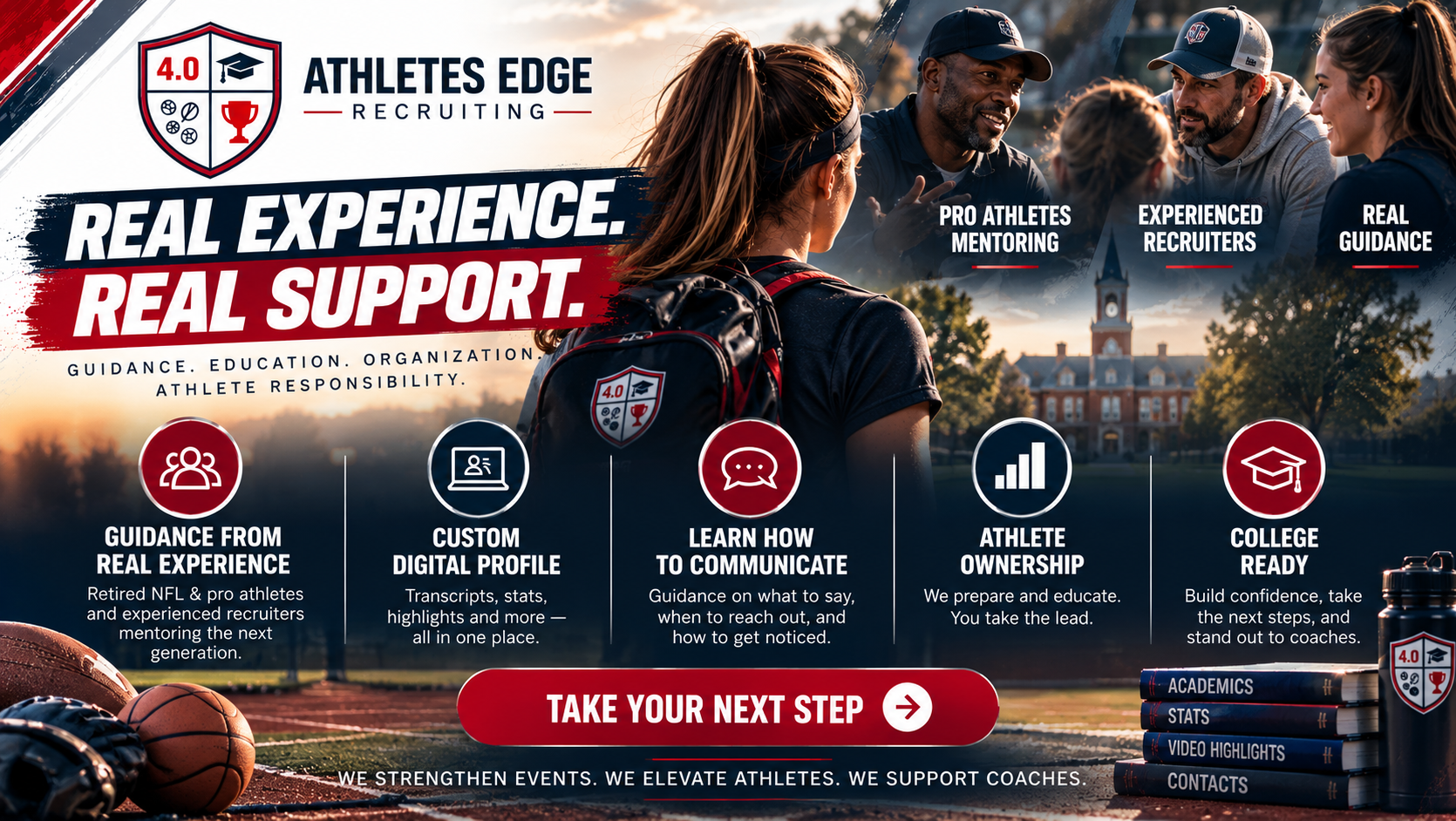
AER works with retired NFL and professional basketball players, along with recruiters who have played professionally overseas.
They love staying connected to the game and helping the next generation.
Their involvement includes mentoring athletes, answering questions, reviewing profiles, reviewing football footage, and sharing lessons from their own experiences.
They are valuable resources because they understand the commitment, sacrifices, setbacks, and excitement of pursuing athletic opportunities. They bring that perspective to conversations with young athletes who are finding their own way.
They’re excited to support athletes and see the talent developing in their communities. That enthusiasm matters to me, because our mission depends on people who believe in helping young people grow.
Does AER Handle Recruiting for Your Athlete?
No. We help athletes prepare for and take ownership of their recruiting journey.
I believe athletes need to develop their own communication with college coaches. Parents can support, encourage, and help with organization, while athletes practice introducing themselves, asking questions, and following through.
Our role is to make that process clearer. We organize information into a digital profile, provide education, and guide athletes on how to communicate.
Taking ownership of your recruiting journey means learning to communicate with coaches, keep your information current, and follow through.
The athlete remains responsible for reaching out, keeping information current, responding to coaches, and continuing to develop academically and athletically.
We teach responsibility and communication because those skills serve athletes throughout college and beyond.
How Much Does AER Cost?
AER’s Elite Digital Profile is listed at $297, with additional update options available.
Our profile service and an NCSA membership have different scopes. The amount our family spent reflects our own purchase, rather than a universal NCSA price or a comparison of identical packages.
When evaluating any service, ask:
What exactly is included?
How will we receive guidance?
Are there additional or ongoing costs?
Does the format fit our schedule?
What will our athlete still need to do?
An affordable service should address a real need and give your family something useful to put into practice.
So, Is NCSA Worth It?
NCSA may be worthwhile for a family whose needs, schedule, and budget align with its services. We found good information there, and we understand why parents choose it.
For our family, the expense and the challenge of fitting meetings into a busy schedule helped clarify what we wanted to offer through AER.
We provide a focused approach built around accessible education, personal guidance, professional presentation, and athlete ownership.
No service can guarantee a scholarship, roster spot, or college offer. What we can do is help athletes understand their next steps and become more organized, confident communicators.
Start With One Clear Next Step
If your family is wondering where to begin, start with AER’s free Recruitable Score™ and recruiting resources.
Then help your athlete gather their information, identify what needs attention, and take an active role in the process.
Visit AthletesEdgeRecruiting.com to get started.
We strengthen events. We elevate athletes. We support coaches.
